
What Living in New Cassel, NY Actually Feels Like Day to Day
Step off the Long Island Rail Road at Westbury station on a Saturday morning and walk a few blocks west into New Cassel, NY, and the neighborhood announces itself quickly. The smell of fresh pan dulce drifts from a bakery on Union Avenue. A group of men argue cheerfully over a domino table outside a bodega. Kids cut through the park on bikes while their parents call after them in Spanish. This is not a neighborhood performing itself for newcomers — it simply is what it is, and has been for a long time.
Living in New Cassel, NY means being embedded in one of Nassau County's most genuinely working-class, community-oriented pockets. The housing stock is modest — mostly post-war Cape Cods and ranches on small lots — but the blocks are kept up with evident pride. Front yards get tended. Neighbors know each other's names. The pace is unhurried in a way that feels increasingly rare this close to New York City.
The commute picture is practical. The Westbury LIRR station puts Midtown Manhattan roughly 45 to 55 minutes away on the Port Jefferson or Ronkonkoma branches, which is competitive for Nassau County. Drivers have easy access to the Meadowbrook State Parkway and the Wantagh State Parkway, making both the South Shore beaches and the broader Island accessible on weekends. For daily errands, Old Country Road and the surrounding commercial corridors handle most needs without requiring a highway.
What surprises many first-time visitors is how settled the neighborhood feels. This isn't a place in obvious transition or mid-gentrification flux. It has a stable identity built over decades, and that stability is part of what draws buyers who want a real neighborhood rather than an investment thesis.
The Cultural Identity That Defines the New Cassel, NY Community
The New Cassel, NY community is anchored by a Latino identity that runs deep — particularly Central American and Mexican, with significant Salvadoran, Guatemalan, and Mexican populations that began settling here in earnest during the 1980s and 1990s. That demographic shift transformed what had been a mid-century African American and working-class white neighborhood into something more layered and, frankly, more vibrant.
Walk along Prospect Avenue or Jerusalem Avenue and the evidence is everywhere. Pupuserías sit next to Dominican hair salons. A taqueria with hand-painted signage operates out of what looks like a converted garage and draws a lunch crowd that spills onto the sidewalk. There are small botanicas, money transfer storefronts, and family-run grocery stores stocking produce you won't find at a standard supermarket. These aren't novelties — they are the functional infrastructure of a community that largely serves itself.
The murals matter here too. Several walls in the neighborhood carry large-scale artwork that reflects community history, cultural pride, and local figures. These aren't commissioned corporate beautification projects — they feel earned, like visual expressions of a community that has had to assert its presence and identity in a county that hasn't always made that easy.
Community organizations have played a significant role in shaping New Cassel's civic life. Groups like the New Cassel Community Association and various faith-based organizations have historically worked on issues ranging from housing advocacy to youth programming. The neighborhood has not been without its challenges — overcrowded housing, immigration enforcement pressures, and underinvestment in infrastructure have all been documented concerns — but the community response to those pressures has been organized and persistent.
Parks, Gathering Spots, and Where Neighbors Actually Connect
New Cassel is not a neighborhood built around a downtown strip or a curated main street. Its social life happens in more organic, distributed ways — and once you understand that, the texture of daily life here makes more sense.
Carman Avenue and the Surrounding Blocks
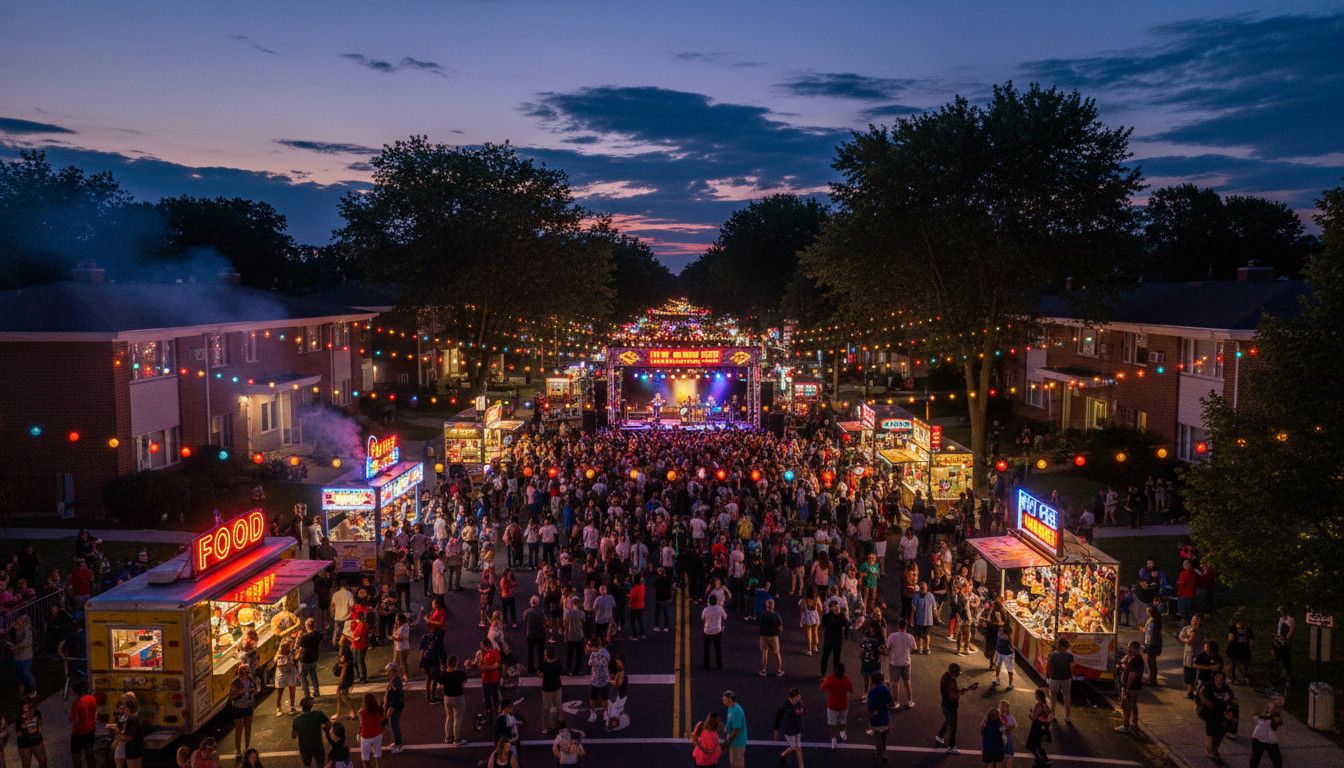
The commercial stretch along Carman Avenue functions as an informal gathering corridor. On weekend evenings especially, the sidewalks fill with families, and the restaurants and food trucks that set up along the route do brisk business. It's not a destination for outsiders, which is precisely what makes it feel authentic to the people who live here.
New Cassel Park and Recreation
The neighborhood has access to local parks including facilities maintained by Nassau County and the Town of North Hempstead. Residents frequently cite these green spaces as important to daily life, particularly for families with young children. The parks serve as de facto community centers — weekend soccer games draw serious crowds, and informal leagues organized through word of mouth and community WhatsApp groups are a real part of social life here.
Faith Communities
Churches and faith communities are significant connective tissue in New Cassel. Several Spanish-language evangelical congregations and Catholic parishes serve the community, and their role extends well beyond Sunday services — they run food pantries, ESL classes, and youth programs that fill gaps left by underfunded public services. For many residents, the church is where you find out about a job, get help navigating a bureaucratic problem, or simply feel seen.
Is New Cassel, NY a Good Place to Live? Let's Be Honest
This is the question prospective buyers actually want answered, and it deserves a straight response rather than a promotional one.
Is New Cassel, NY a good place to live? For the right buyer, genuinely yes. For others, it requires honest self-assessment.
The schools are the most common concern raised by families. New Cassel falls within the Westbury Union Free School District, which has historically faced challenges with academic performance metrics and resource constraints. Test scores at several schools in the district have run below state averages, and this is a real consideration for families with school-age children. That said, the district has made documented efforts at improvement, and many families in the community supplement with after-school programs, community tutoring, and strong parental involvement. It's not a dealbreaker for everyone, but it's a factor that should be weighed honestly rather than glossed over.
Public safety is another area where perception and reality sometimes diverge. New Cassel has had periods of elevated crime relative to some surrounding communities, and local news coverage has not always been flattering. The more accurate picture, according to long-term residents, is a neighborhood where most blocks are quiet and where community relationships — including with local law enforcement — have improved meaningfully over the past decade. Nassau County Police Department's Fourth Precinct covers the area, and community policing initiatives have had some documented impact.
What the neighborhood does well is harder to quantify but no less real: a genuine sense of belonging for residents who share its cultural identity, housing costs that allow working families to build equity rather than just pay rent, and a community fabric that shows up when people need it. Those are not small things.
The honest summary: New Cassel rewards buyers who are looking for community over cachet, and who understand that a neighborhood's value isn't fully captured in school ranking tables or crime heat maps.
The Real Estate Reality: What Buyers Should Know
Here is where the numbers make a compelling case.
Median home prices in New Cassel have historically run $100,000 to $150,000 below comparable properties in neighboring Westbury and Mineola — two communities that share similar commute access and proximity to Nassau County's commercial corridors. That gap represents a meaningful difference in what a buyer can afford, what their down payment covers, and what their monthly payment looks like over a 30-year term.
The housing stock is predominantly single-family — Cape Cods, ranches, and split-levels built largely between the 1940s and 1970s. Lot sizes are modest, typically in the 4,000 to 6,000 square foot range. Many homes have been updated by long-term owners, while others represent genuine renovation opportunities for buyers willing to put in the work. The mix creates a market where patient, informed buyers can find real value.
For buyers who want to compare New Cassel listings directly against nearby zip codes — Westbury, Mineola, Carle Place — tools like Opulist let you filter by neighborhood and run side-by-side comparisons that make the price differential concrete rather than abstract. That kind of data-driven clarity matters when you're trying to decide whether the savings justify the tradeoffs, or whether a slightly higher price point in an adjacent community makes more sense for your specific situation.
At Opulist, we combine the resources of Opulence Realty Group — a licensed brokerage with in-house agents who know Nassau County's neighborhood-level nuances — with Opulence Home Equity, our licensed mortgage lending and brokerage arm. That integration means a buyer exploring New Cassel can work with an agent who understands the local market and a loan officer who can model out financing scenarios, including FHA options and down payment assistance programs that are particularly relevant at New Cassel's price points, all under one roof. For first-time buyers especially, that continuity reduces friction at a stage of the process that is already stressful enough.
One practical note: Nassau County property taxes apply here as they do across the Island, and New Cassel's effective tax rates are worth factoring into your monthly cost modeling. Your Opulist agent can walk through current assessed values and recent grievance outcomes for specific properties — a step that experienced Nassau County buyers know to take seriously.
Who Thrives in New Cassel
Not every buyer is the right fit for every neighborhood, and New Cassel is no exception. But the profile of buyers who tend to put down roots here and stay for decades is fairly consistent.
First-time buyers who have been priced out of Westbury, Garden City, or Mineola often find that New Cassel gives them the Nassau County foothold they need — a real house, a real yard, and a real mortgage payment — without requiring them to stretch into financial overextension. The equity they build over five to ten years frequently becomes the foundation for their next move, whether that's a larger home in the same area or a different community entirely.
Buyers with ties to the Latino community — whether they grew up in a similar neighborhood, have family in the area, or simply feel at home in a Spanish-speaking, culturally expressive environment — often describe New Cassel as one of the few places on Long Island where they feel genuinely comfortable rather than like an outsider in their own home.
Investors and house-hackers have also found the neighborhood attractive, given the price points and the consistent rental demand from working families who need affordable housing in Nassau County. That dynamic is worth understanding as a buyer: it means the neighborhood has a mix of owner-occupants and renters, which affects block-by-block character in ways that vary enough to make property selection — and local knowledge — genuinely important.
What New Cassel asks of its buyers is openness — to a neighborhood that doesn't announce its value loudly, to a community that has built something real without much outside recognition, and to the idea that a home's worth is measured in more than its Zestimate. Buyers who bring that openness tend to find exactly what they were looking for.