The Dutchess County Dilemma: Same Dream, Three Very Different Lifestyles
The pitch sounds identical no matter who's making it: leave the city, get some land, breathe actual air, and still make it back to Manhattan when you need to. But Dutchess County real estate is not one market — it's several, layered on top of each other, and the town you choose will shape your daily life more than the house itself. If you've been searching dutchess county homes for sale and feeling overwhelmed by the range of prices, property sizes, and commute times, you're not confused — you're just looking at three distinct submarkets that happen to share a county line.
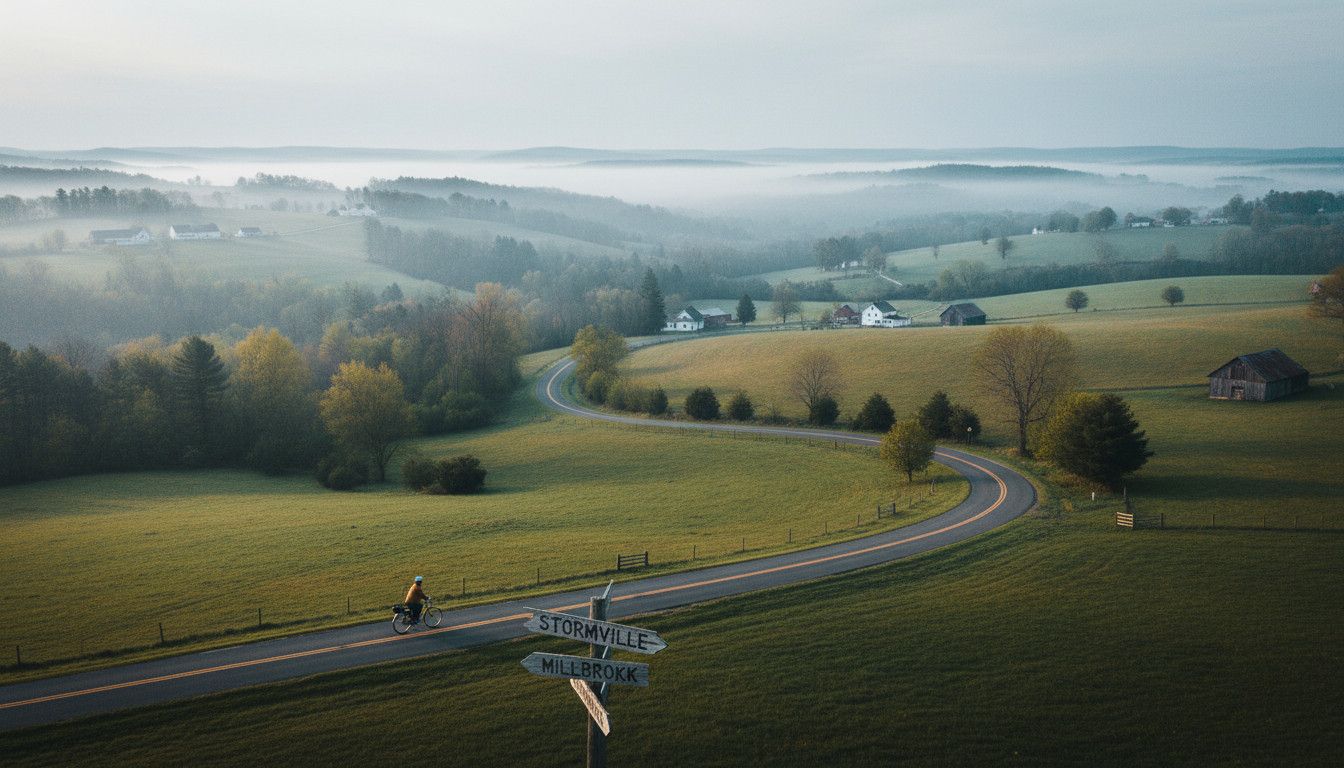
Stormville sits in the southwestern corner of the county, quiet and largely unbranded, where the value-per-acre math is hard to argue with. Pawling anchors the southeastern edge with a functioning village, a Metro-North station, and a commuter-friendly identity that's made it one of the most consistently in-demand towns in the Hudson Valley. Millbrook occupies the rolling center of the county with a reputation built on horse farms, old money, and a main street that looks like it was art-directed. Each town is genuinely appealing. None of them is right for everyone. This breakdown is designed to help you figure out which one is actually right for you.
Stormville, NY: Maximum Acreage, Minimum Pretension
Stormville doesn't have a downtown. It doesn't have a train station. It doesn't have a wine bar or a farm-to-table restaurant with a six-week reservation list. What it has is land — real land, at prices that still feel like a decade ago compared to what's happening in more marketed corners of the Hudson Valley. If your version of the country dream involves a few acres, a barn, a vegetable garden the size of most Brooklyn backyards, and neighbors who are not interested in your Instagram aesthetic, Stormville NY real estate deserves serious attention.
What the Market Actually Looks Like
Homes for sale in Stormville NY tend to cluster in a range that would be laughable if you tried to replicate the lot sizes anywhere closer to the city. It's genuinely common to find 2 to 5-acre parcels listed under $500,000, and properties with 10 or more acres regularly appear under $700,000 — numbers that would buy you a one-bedroom condo in a secondary Brooklyn neighborhood. The housing stock skews toward colonials, raised ranches, and cape cods from the 1970s through the 1990s, with a scattering of older farmhouses and newer construction on larger lots. These are not Instagram houses. They are solid, livable homes on real land, and that distinction matters depending on what you're actually trying to do with your life up here.
The Commute Conversation
Here's where Stormville requires honesty. There is no train. The closest Metro-North access is the Harlem Line station in Pawling, roughly 15 to 20 minutes by car, or the Beacon station on the Hudson Line, about 25 minutes west. If you're commuting to Manhattan multiple days a week, you're either driving to a station or you're driving all the way — Route 84 connects you to I-684 and eventually the Saw Mill, but plan on 90 minutes to two hours depending on when you leave and how lucky you are. Stormville works best for people who have gone fully remote, who commute once or twice a week and don't mind the drive, or who have made peace with the fact that proximity to the city was never really the point.
Weekend Life
The Stormville Airport Antique Show — one of the largest outdoor antique markets in the Northeast — runs several times a year right in town and draws serious collectors from across the region. The Appalachian Trail crosses nearby. Fahnestock State Park is a short drive. You're close enough to Beacon to access its galleries, restaurants, and general cultural energy without living in it. For a certain kind of buyer, that's the ideal arrangement.
Pawling, NY: The Train-Town Sweet Spot for the Part-Time Commuter
Pawling has figured something out that most Hudson Valley towns haven't: how to be genuinely charming without being precious about it. The village has a working main street — a hardware store, a diner, a few good restaurants, an independent bookshop — and it has a Metro-North station on the Harlem Line that makes the commute math work for people who still need to show up in Manhattan with some regularity. That combination is rarer than it sounds, and it's why Pawling has maintained strong buyer demand even as other markets have cooled.
The Commute Is the Product
The Pawling station puts you at Grand Central Terminal in roughly 90 minutes on a direct Harlem Line train, with multiple departures during peak hours. For someone commuting two or three days a week, that's manageable — especially if you're working on a laptop and treating the train as productive time rather than dead time. The station itself is walkable from the village center, which means you can theoretically arrive in Pawling, walk to dinner, and never touch your car. That's not a small thing when you're trying to convince a partner who isn't fully sold on the move.
What You Pay for the Convenience
Pawling carries a premium over Stormville, and it's earned. Median sale prices in Pawling have consistently run in the $500,000 to $750,000 range for single-family homes, with the upper end of the market — larger properties, equestrian setups, historic homes — pushing well past a million. Lot sizes are more modest than what you'll find in Stormville; a half-acre to two acres is typical in the village and its immediate surroundings, though larger parcels exist further out. The tradeoff is walkability, community infrastructure, and that train.
The Village Character
Pawling has a genuine small-town identity that predates the Hudson Valley lifestyle trend. The Pawling Central School District serves the community with a reputation that draws families specifically. There's a strong local athletic culture — the Pawling Golf Club has been operating since 1914, and the town has a long history with prep school athletics through the Pawling School. It feels lived-in rather than curated, which is either exactly what you want or slightly less than what you were picturing, depending on your expectations.
Millbrook, NY: Old-Money Equestrian Country With a Price Tag to Match
Millbrook is the town people picture when they imagine a certain version of upstate New York — the version with stone walls along the road, horse paddocks visible from the highway, and a village center that manages to feel both casual and expensive at the same time. It is genuinely beautiful. It is also genuinely priced. If you're browsing dutchess county homes for sale and Millbrook keeps appearing at the top of your budget or above it, that's not a coincidence — it's the market reflecting the land quality, the community identity, and the decades of investment that have gone into both.
The Equestrian Economy
Millbrook's identity is inseparable from horses. The Millbrook Hunt, one of the oldest fox hunts in the country, has operated continuously since 1908. The landscape around the village — rolling hills, open pasture, mature hardwood forests — is genuinely suited to equestrian use in a way that isn't true everywhere in the Hudson Valley. If you're buying for a horse operation, or you want to be adjacent to that world without participating in it, Millbrook is the address. Properties with barns, paddocks, and riding trails command significant premiums, and the buyers competing for them tend to have the resources to pay those premiums without much negotiation.
What the Numbers Look Like
Median sale prices in Millbrook regularly exceed $900,000, and the upper end of the market has no real ceiling — significant estates in the surrounding township have traded at $3 million, $5 million, and beyond. Even modest single-family homes in the village itself tend to list above $600,000. The land is the asset here; a 50-acre parcel with a farmhouse that needs work will still carry a price that reflects the acreage and the location, not just the condition of the structure. For buyers coming from high-cost urban markets, the value proposition can still make sense — but it requires a different calculation than what you'd run in Stormville.
Village Life and Amenities
Millbrook's village center punches above its size. Millbrook Vineyards and Winery, one of the Hudson Valley's most established producers, is minutes away. The Millbrook Diner is an institution. Merritt Bookshop has been operating independently for decades and is the kind of bookstore that makes people feel good about small towns. The Innisfree Garden, a public landscape garden modeled on Chinese garden design, is one of the genuinely underrated cultural sites in the entire Hudson Valley. The Millbrook Central School District is well-regarded, and the community has a strong sense of its own identity — which can read as welcoming or insular depending on how you approach it.
Side-by-Side: Commute, Cost, Schools, and Land
If you want to make the comparison concrete, here's how the three towns stack up across the dimensions that actually drive buying decisions:
Commute to Manhattan: Pawling wins on transit access — 90 minutes to Grand Central on Metro-North, with a walkable station. Stormville requires a car to reach any train, adding 15 to 25 minutes before you even board. Millbrook is the furthest from Metro-North infrastructure; most Millbrook residents drive to the Wassaic station at the end of the Harlem Line (about 20 minutes) or commit to a full car commute on the Taconic State Parkway, which runs roughly 90 minutes to two hours in reasonable conditions.
Price per acre: Stormville is the clear leader. Two-plus acres under $600,000 is a realistic expectation, not an outlier. Pawling offers less land for similar or higher prices, with the premium going toward location and infrastructure. Millbrook prices land at a premium that reflects both quality and prestige — expect to pay significantly more per acre than either alternative.
Schools: All three towns fall within solid Dutchess County school districts. Pawling Central and Millbrook Central both have strong reputations and active parent communities. The Arlington Central School District, which serves parts of the Stormville area, is one of the larger districts in the county and has strong academic programs alongside the logistical complexity that comes with scale.
Weekend infrastructure: Pawling has the most functional village for daily errands and casual dining. Millbrook has the most curated amenity set — winery, bookshop, garden — with less practical retail. Stormville has the least in-town infrastructure but the best access to outdoor recreation and the most privacy.
Who each town is actually for: Stormville is for the buyer who has maximized remote work flexibility and wants the most land for the least money. Pawling is for the buyer who still has a foot in the city and needs the commute to be genuinely manageable. Millbrook is for the buyer who has decided that the Hudson Valley is the destination, not the compromise — and who has the budget to buy into the best version of it.
How to Use Opulist to Run Your Own Comparison
The analysis above gives you a framework, but the right answer is always specific to your situation — your actual commute schedule, your budget, how much land you genuinely need versus how much you think you want, and what your household's daily life actually looks like. That's where a tool built for this kind of search becomes useful.
Opulist lets you filter dutchess county homes for sale by town, acreage, price range, and property type simultaneously — so you can run a Stormville search filtered to 3-plus acres under $600,000 and a Pawling search filtered to properties within a mile of the train station and compare what's actually available right now, not what the market looked like six months ago. The listings are connected to our in-house agents at Opulence Realty Group, who work specifically in the Hudson Valley and can tell you things about individual roads and micro-neighborhoods that don't show up in any database.
If financing is part of the equation — and for most buyers it is — Opulence Home Equity, our in-house mortgage lending arm, can run the numbers on jumbo products for Millbrook-range purchases, conventional financing for Pawling, or portfolio loans for properties with unusual acreage or agricultural components that sometimes complicate standard underwriting. Having the brokerage and the lender under one roof means fewer handoffs and fewer surprises between contract and closing.
The Hudson Valley move is worth making. Dutchess County specifically has the infrastructure, the landscape, and the community depth to support a real life — not just a weekend life. The question is just which version of that life you're actually building, and which town is set up to support it. Start with the search, get specific about your filters, and let the inventory tell you what's possible right now. The right property is probably already listed — you just need to be looking in the right town.