
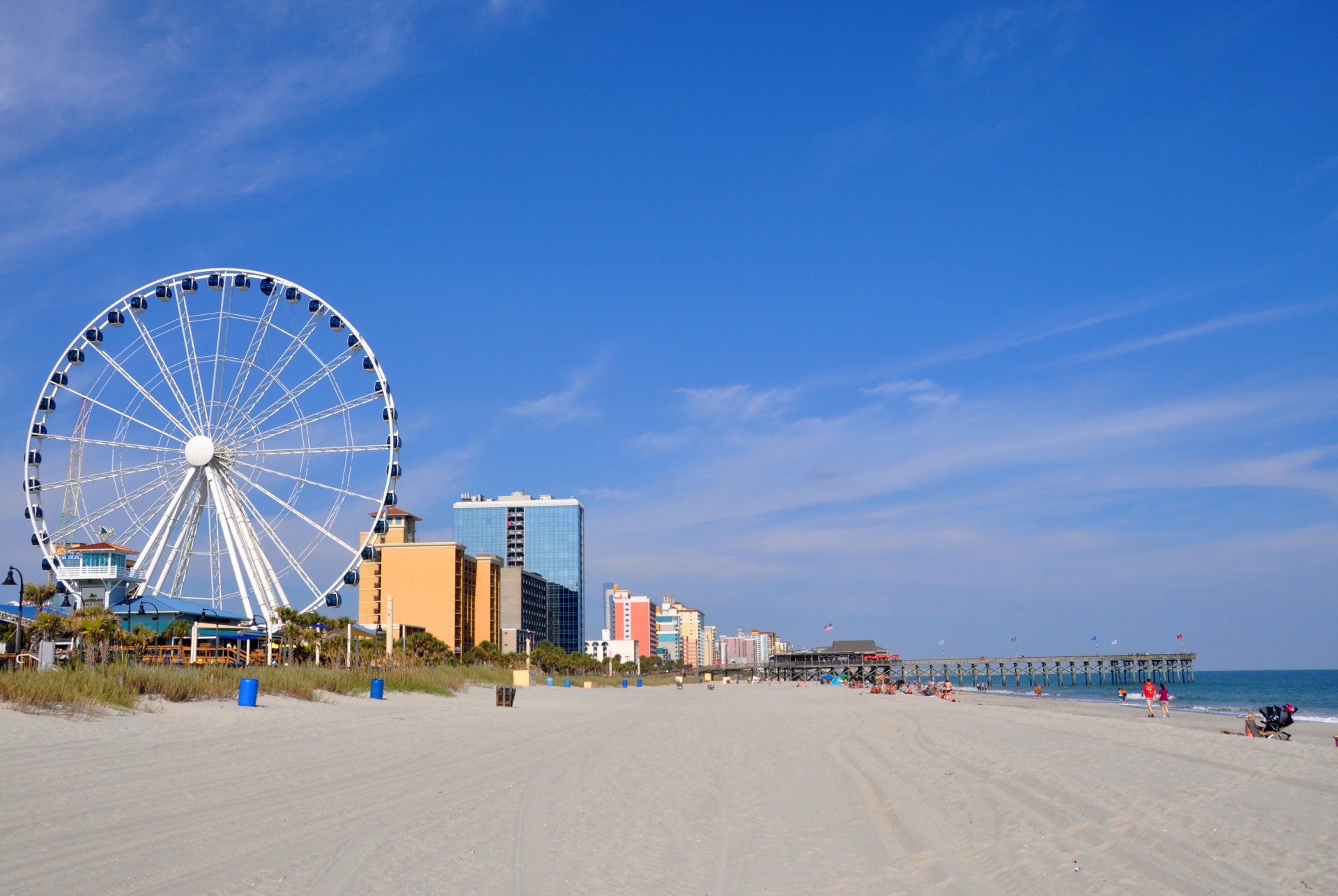
Situated at the geographic center of the Grand Strand — a continuous 60-mile arc of Atlantic coastline in Horry County — Myrtle Beach, South Carolina has been drawing people to its shores since the Conway & Seashore Railroad first delivered visitors to the beach in 1900. What sets Myrtle Beach apart from neighboring communities like North Myrtle Beach or Surfside Beach is its scale and density of amenities: 86 championship golf courses, miles of walkable oceanfront, and a year-round tourism economy that supports a permanent population of over 35,000 residents. The Myrtle Beach Boardwalk, stretching along the Atlantic and anchored by the SkyWheel observation ride, is the kind of landmark that defines a place — not just for tourists, but for the people who actually call it home. Students here are served by Horry County Schools, one of the larger and faster-growing school districts in South Carolina. With the metro area adding population at one of the fastest rates in the country, those exploring homes for sale in Myrtle Beach SC are looking at a market where coastal living and long-term investment potential genuinely converge.
Welcome to Myrtle Beach
Community Profile
With a median age of 47.3 years and nearly one in four residents over 65, Myrtle Beach wears its identity as a premier retirement and lifestyle destination proudly. This is a community shaped by people who have made a deliberate choice — trading long commutes and cold winters for Grand Strand sunshine and a slower, more rewarding pace of life. That intentionality shows up across the data in compelling ways. The average commute clocks in at just 17.7 minutes, well below the national norm, meaning residents spend far more time enjoying the coast than sitting in traffic.
The local housing market reflects both the area's desirability and its relative value. With a median home value of $367,902 — only modestly above the national median — buyers exploring homes for sale in Myrtle Beach, SC will find that waterfront-adjacent living remains attainable. Median rent of $1,261 per month adds further context for those weighing the rent-versus-own decision, and a homeownership rate of 60.5% signals a community with genuine residential roots rather than a purely transient character.
Intellectually, the community holds its own: 33.5% of residents hold a bachelor's degree or higher — right in line with the national average — and a notable 36.8% of degreed residents concentrated in STEM fields. A diverse population of 348,669 across Horry County, with 13.2% Hispanic/Latino residents and nearly 16% identifying as two or more races, gives Myrtle Beach a cultural richness that continues to deepen. For those browsing houses for sale in Myrtle Beach, South Carolina, the numbers tell a story of a welcoming, sun-soaked community with real staying power.
Things to Do
The Beach & Boardwalk
At the heart of Myrtle Beach life is the Myrtle Beach Boardwalk, a 1.2-mile oceanfront promenade stretching from 14th Avenue North to 2nd Avenue North. Stroll past souvenir shops, casual eateries, and street performers before riding the iconic Myrtle Beach SkyWheel, one of the tallest Ferris wheels on the East Coast, offering sweeping views of the Grand Strand's 60-mile coastline. The boardwalk buzzes year-round but truly comes alive in summer, when outdoor concerts and festivals fill the warm Atlantic evenings.
Family Entertainment
Few destinations rival Myrtle Beach for sheer family-friendly variety. Broadway at the Beach, a sprawling entertainment complex just off U.S. 17, anchors the city's entertainment district with attractions, live shows, and dozens of dining options surrounding a central lake. The area is also home to multiple waterparks, aquariums, and live performance theaters that keep families busy well beyond the beach itself. Families browsing houses for sale in Myrtle Beach South Carolina often cite this density of entertainment as a major draw for putting down roots here.
Golf
Myrtle Beach is arguably the golf capital of the East Coast, with more than 86 championship courses woven throughout the Grand Strand. From oceanside layouts to inland parkland designs, the variety and accessibility of courses here attract dedicated golfers from across the country, particularly during the mild spring and fall shoulder seasons when conditions are ideal.
Dining & Nightlife
With roughly 1,800 restaurants in the greater area, the dining scene spans everything from fresh-off-the-boat seafood shacks to upscale oceanfront dining rooms. Seafood buffets are a beloved local institution, and the restaurant corridor along Kings Highway and Ocean Boulevard offers something for every palate and budget.
Nature & State Parks
Myrtle Beach State Park, located just south of the city center, offers a quieter counterpoint to the resort bustle — with maritime forest trails, a fishing pier, and some of the most pristine beach access on the Grand Strand. It's a favorite escape for residents and a compelling reason why many exploring homes for sale in Myrtle Beach SC prioritize the southern end of the city.
Latest Properties in Myrtle Beach
Loading latest properties...
History
From Timber Tracks to Tourism Boom
Long before the first hotel or golf course appeared, the land that is now Myrtle Beach belonged to the Waccamaw people, who fished its shores and traveled its waterways for centuries. European settlers arrived in the late 18th century, receiving colonial land grants along what they called Long Bay, but the sandy coastal soil resisted serious agriculture, and the area remained remote well into the 1800s. The Withers family — among the few persistent settlers — ultimately abandoned their coastal plots after a devastating 1822 hurricane swept their home into the sea, leaving the shoreline largely to the elements.
The modern city's story begins in 1881, when the Burroughs and Collins Company of Conway purchased much of that abandoned land for its timber value. Franklin Burroughs envisioned something grander: a seaside resort to rival the beaches of Florida and the Northeast. Though Burroughs died in 1897, his sons carried out the vision, completing the Conway & Seashore Railroad in 1900 and opening the Seaside Inn in 1901. The settlement was renamed Myrtle Beach — honoring the abundant wax myrtle shrubs along the shore — and oceanfront lots sold for just $25 each. The area incorporated as a town in 1938 and became a city in 1957.
That early infrastructure laid the geographic bones of today's market. The corridors established by the railroad and Kings Highway — finally paved in 1940 — shaped where neighborhoods grew and where commercial strips took hold. For buyers exploring homes for sale in Myrtle Beach SC today, those original development patterns are still visible: older residential pockets near the historic core contrast with sprawling resort-adjacent communities that expanded through the postwar decades and beyond, as the city evolved from a regional getaway into one of the most visited destinations in the United States.
Weather
Myrtle Beach enjoys a humid subtropical climate, shaped by its position along the Atlantic Coast at roughly 33 degrees north latitude. The ocean acts as a natural moderator, keeping temperatures milder than inland South Carolina while also adding humidity and the occasional dramatic coastal storm.
Summers are long, warm, and humid, with daytime highs typically climbing into the upper 80s to low 90s°F and overnight lows settling in the mid-to-upper 70s. The Atlantic breeze provides some relief, but heat index values can push conditions into genuinely sweltering territory from June through September. Winters are mild by most standards — highs generally range from the mid-50s to low 60s°F, with lows dipping into the 30s on the coldest nights. Hard freezes are infrequent, and measurable snowfall is a rarity.
Annual rainfall is generous, averaging around 50 to 55 inches, distributed fairly evenly throughout the year with a slight peak in summer from afternoon thunderstorms. Hurricane season, running June through November, is a meaningful consideration for coastal homeowners — storm shutters, flood insurance, and wind-resistant construction are practical realities rather than optional extras.
For those exploring homes for sale in Myrtle Beach, SC, the climate is largely a selling point: outdoor living is possible for most of the year, and mild winters reduce heating costs significantly. However, the humidity and salt air do accelerate wear on exteriors, roofing, and HVAC systems, making routine maintenance a higher priority than in drier inland markets.
Myrtle Beach Market Analytics
Can I Afford Myrtle Beach?
Weather