
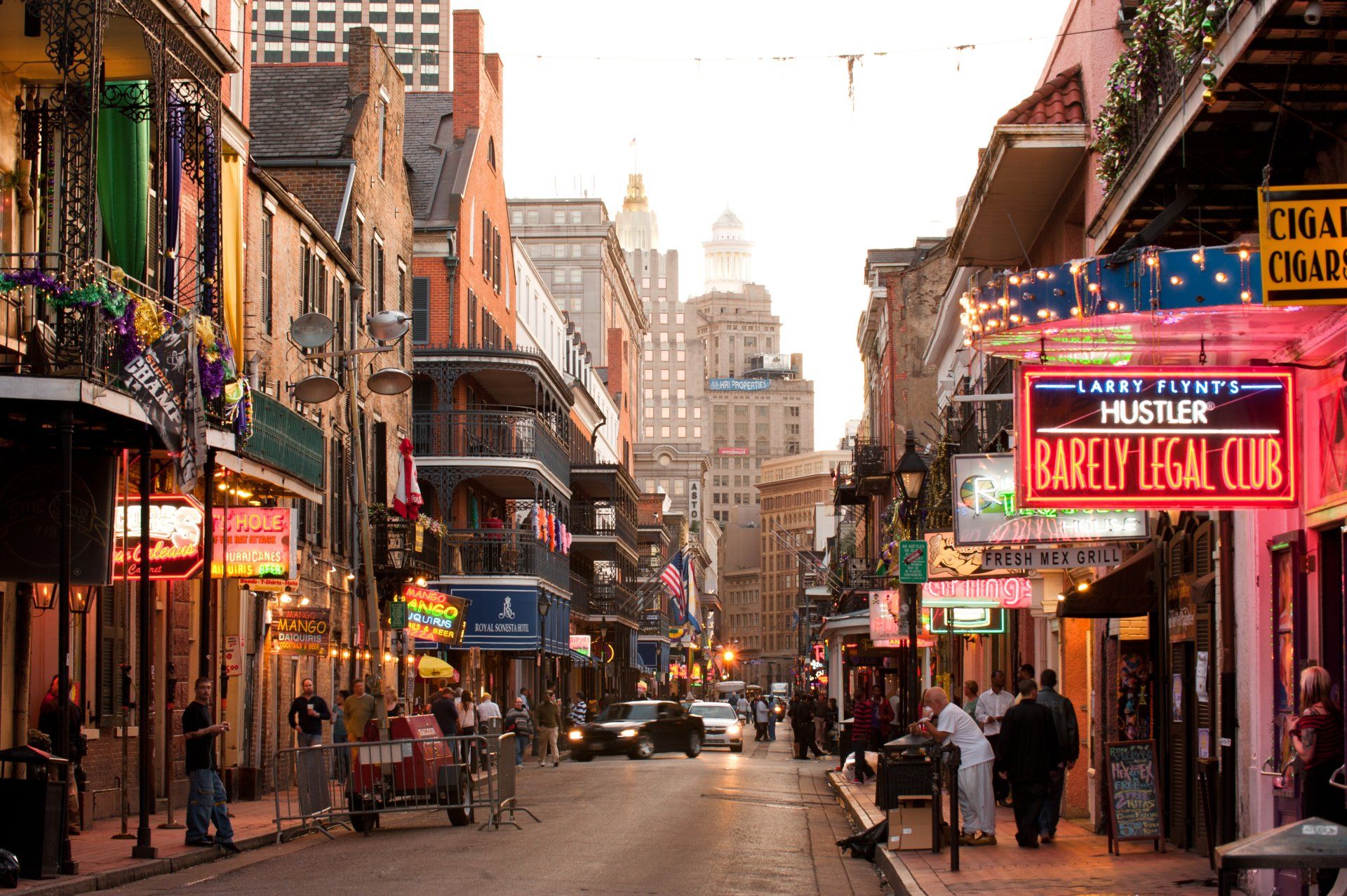
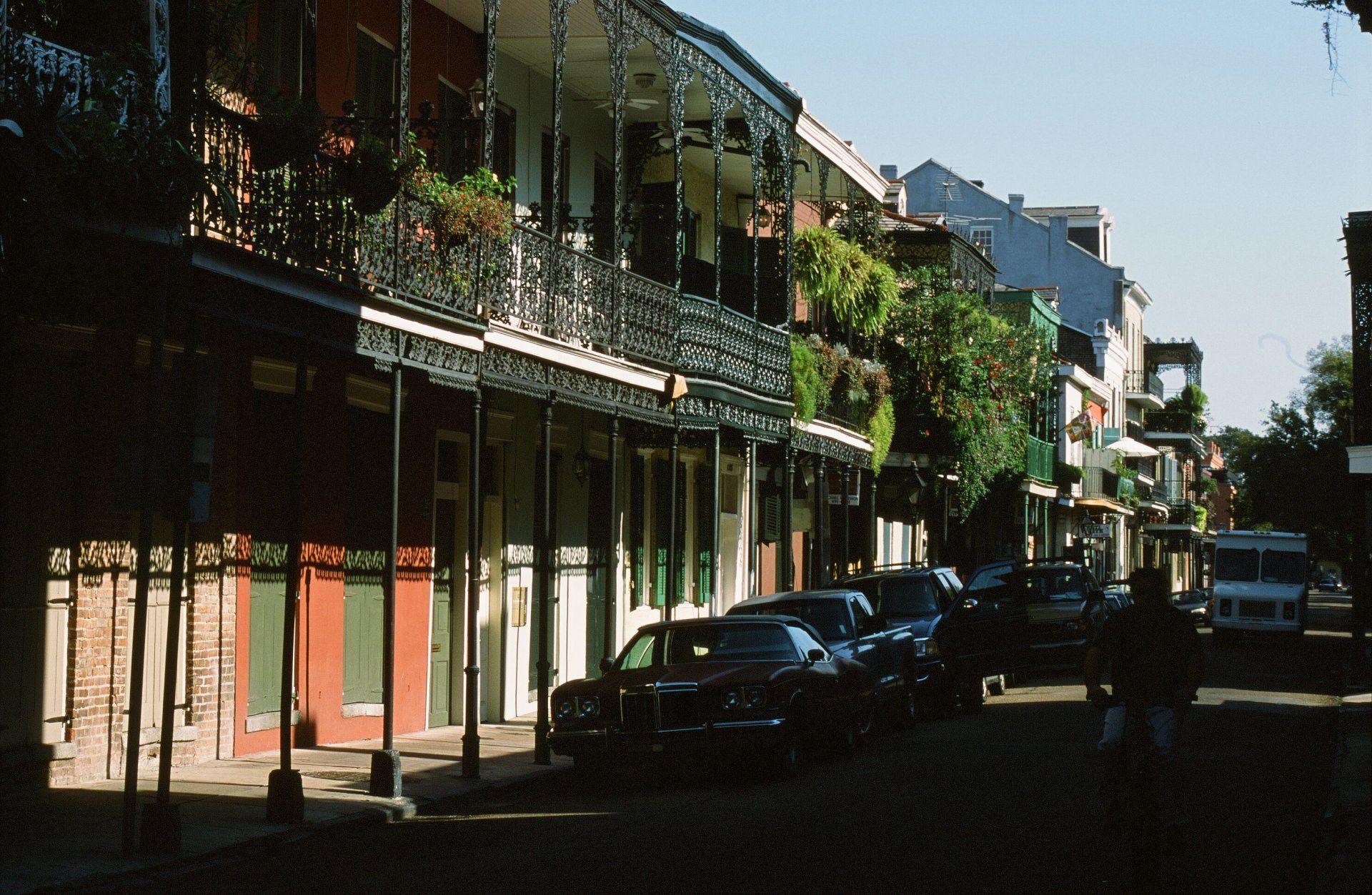
Founded in 1718 by French colonial governor Jean-Baptiste Le Moyne de Bienville, New Orleans sits at a dramatic crescent bend of the Mississippi River in southeastern Louisiana, roughly 100 miles from the Gulf of Mexico. As the most populous city in Louisiana and the coterminous seat of Orleans Parish, it occupies a singular position in American history and culture that no neighboring city — not Baton Rouge, not Metairie, not Shreveport — can replicate. New Orleans is the birthplace of jazz, a city shaped by three centuries of French, Spanish, African, and Creole influences that produced an architecture, a cuisine, and a way of life entirely its own. The French Quarter, the oldest urban neighborhood in the Mississippi Valley, anchors a cityscape that ranges from antebellum Garden District mansions to the iconic Caesars Superdome. The Streetcar lines along St. Charles Avenue connect residents to Uptown, Tulane University, and the Central Business District without a car. With a median home price of $270,000 and a cost of living below the national average, New Orleans offers buyers and investors a rare opportunity to own a piece of one of America's most historically layered and culturally irreplaceable cities — one that continues to rebuild, reinvent, and reward those who choose to call it home.
Welcome to New Orleans
Community Profile
One of America's most culturally singular cities, New Orleans draws a remarkably diverse and well-educated population across its 928,503 residents. The median age of 38.8 years sits right at the national pulse, but the real story is in the age spread: a robust 16.7% of residents fall in the 30–39 bracket, signaling a city energized by young professionals and growing households, while a meaningful 17.2% are 65 or older — a multigenerational mix that gives neighborhoods their layered, lived-in character.
Educational attainment here is genuinely impressive. 42.3% of residents hold a bachelor's degree or higher — well above the national average of roughly 33% — and nearly 1 in 5 residents (19.7%) have earned a graduate degree, reflecting the influence of world-class universities and a thriving medical and research sector. The median household income of $56,631 runs below the national median, but with a median home value of $317,784 — meaningfully under the national benchmark of ~$330,000 — purchasing power stretches further here than in many comparable metros. Nearly 3 in 10 households (29.4%) earn six figures, pointing to a strong professional core. Commutes average just 22.6 minutes, a genuine quality-of-life advantage, and the city's extraordinary diversity — with residents identifying across every major background — makes New Orleans one of the most authentically multicultural places to call home in the American South.
Things to Do
Arts & Culture
New Orleans is one of America's most culturally rich cities, and no visit is complete without exploring the French Quarter, the city's oldest neighborhood and its beating cultural heart. The iconic St. Louis Cathedral on Jackson Square has anchored the city since the 18th century, while the surrounding streets overflow with galleries, street musicians, and the unmistakable energy that makes New Orleans singular. The New Orleans Museum of Art in City Park houses a permanent collection spanning 5,000 years, and the adjacent Sydney and Walda Besthoff Sculpture Garden is free and open daily. For jazz lovers, Frenchmen Street in the Marigny neighborhood offers live music nightly in an authentic, locals-first atmosphere — a welcome contrast to the tourist bustle of Bourbon Street.
Dining
New Orleans' Creole cuisine is world-famous, and the city delivers at every price point. The French Quarter and Magazine Street corridor offer some of the South's most celebrated dining, from classic beignets at Café Du Monde to legendary po'boys, gumbo, and crawfish étouffée at neighborhood institutions throughout Uptown and Mid-City. The city's food culture is inseparable from its identity — eating well here is not a luxury, it's a way of life.
Outdoor Recreation
City Park, one of the largest urban parks in the country at over 1,300 acres, offers jogging and cycling paths, paddleboats, a botanical garden, and the beloved Storyland playground. The Audubon Park loop along the river in Uptown is a favorite for runners and families, and connects to the Audubon Zoo, home to white alligators and Louisiana swamp exhibits. The Lafitte Greenway provides a multi-use trail linking Mid-City to the French Quarter.
Family Activities & Sports
Families can spend a full day at the Audubon Aquarium of the Americas on the riverfront, or board a steamboat cruise along the Mississippi for a uniquely historical perspective on the city. Sports fans rally around the New Orleans Saints and Pelicans, both of whom play at the iconic Caesars Superdome and Smoothie King Center respectively, located in the Central Business District. And of course, Mardi Gras — celebrated each February or early March — remains one of the world's great festivals, transforming the entire city into an unforgettable spectacle of parades, music, and community.
Latest Properties in New Orleans
Loading latest properties...
History
From Colonial Outpost to Modern Market
New Orleans was founded in 1718 by French colonial governor Jean-Baptiste Le Moyne de Bienville, who established La Nouvelle-Orléans on a strategic bend of the Mississippi River — a location chosen for commerce that still defines the city's economic identity today. Named in honor of Philippe II, Duke of Orléans, the city passed from French to Spanish control in 1762, then back to France before the United States acquired it through the Louisiana Purchase of 1803. That layered colonial history is still visible in the built environment: the French Quarter's grid of streets, oriented to the river rather than the compass, and its Spanish Creole architecture reflect centuries of overlapping governance that no other American city can claim.
By 1840, New Orleans was the third most populous city in the United States, its wealth built on the Mississippi River trade and the Port of New Orleans. That commercial dominance shaped the grand residential architecture of the Garden District and Uptown — neighborhoods developed through the 19th century as the city expanded upriver — which remain among the most sought-after addresses in today's market. Twentieth-century growth pushed northward toward Lake Pontchartrain through land reclamation, creating Mid-City, Gentilly, and Lakeview, neighborhoods whose post-Katrina recovery trajectories now vary widely in home values.
Hurricane Katrina in August 2005 remains the defining event of the modern real estate landscape. The storm flooded more than 80% of the city, killed over 1,800 people, and triggered a population decline exceeding 50%. The subsequent rebuilding era reshaped neighborhood demographics and property values dramatically, with gentrification concerns following investment into areas like the Bywater and Tremé. Today, with a median home price of $270,000 and median rent of $1,400, New Orleans offers relative affordability — but buyers must weigh that against ongoing flood risk, subsidence, and insurance costs that are a direct legacy of the city's geography and history.
Weather
New Orleans experiences a humid subtropical climate (Köppen Cfa classification), shaped by its position in the Mississippi River delta near the Gulf of Mexico. The city sits at roughly 30 degrees north latitude, low enough to feel the full force of Gulf moisture year-round, and the results are dramatic in every season.
Summers are long, hot, and intensely humid. Daily highs routinely climb into the low-to-mid 90s°F from June through August, while overnight lows hover in the mid-to-upper 70s. The real story, however, is the heat index — Gulf humidity regularly pushes the "feels like" temperature well past 100°F, making air conditioning not a luxury but a necessity. Winters are mild by most standards, with average highs in the low-to-mid 60s°F and lows dipping into the upper 40s. Freezing temperatures are rare but do occur, occasionally bringing ice storms that can catch residents off guard.
New Orleans receives approximately 62 inches of rainfall annually, among the highest of any major American city, distributed fairly evenly across the year but peaking during the Atlantic hurricane season from June through November. Afternoon thunderstorms are a summer staple, and the city's below-sea-level topography means even moderate downpours can cause localized flooding.
For real estate, the climate carries real consequences. Cooling costs dominate household energy budgets for roughly eight months of the year. Flood insurance is a critical consideration for most properties. The persistent heat and humidity accelerate wear on roofing, siding, and HVAC systems, making routine maintenance especially important for homeowners.
New Orleans Market Analytics
Can I Afford New Orleans?
Neighborhoods in New Orleans
Weather